
Chapter One: Village of Thornwick
from Murder in Thornwick: Aldermere House by Rosie Bee
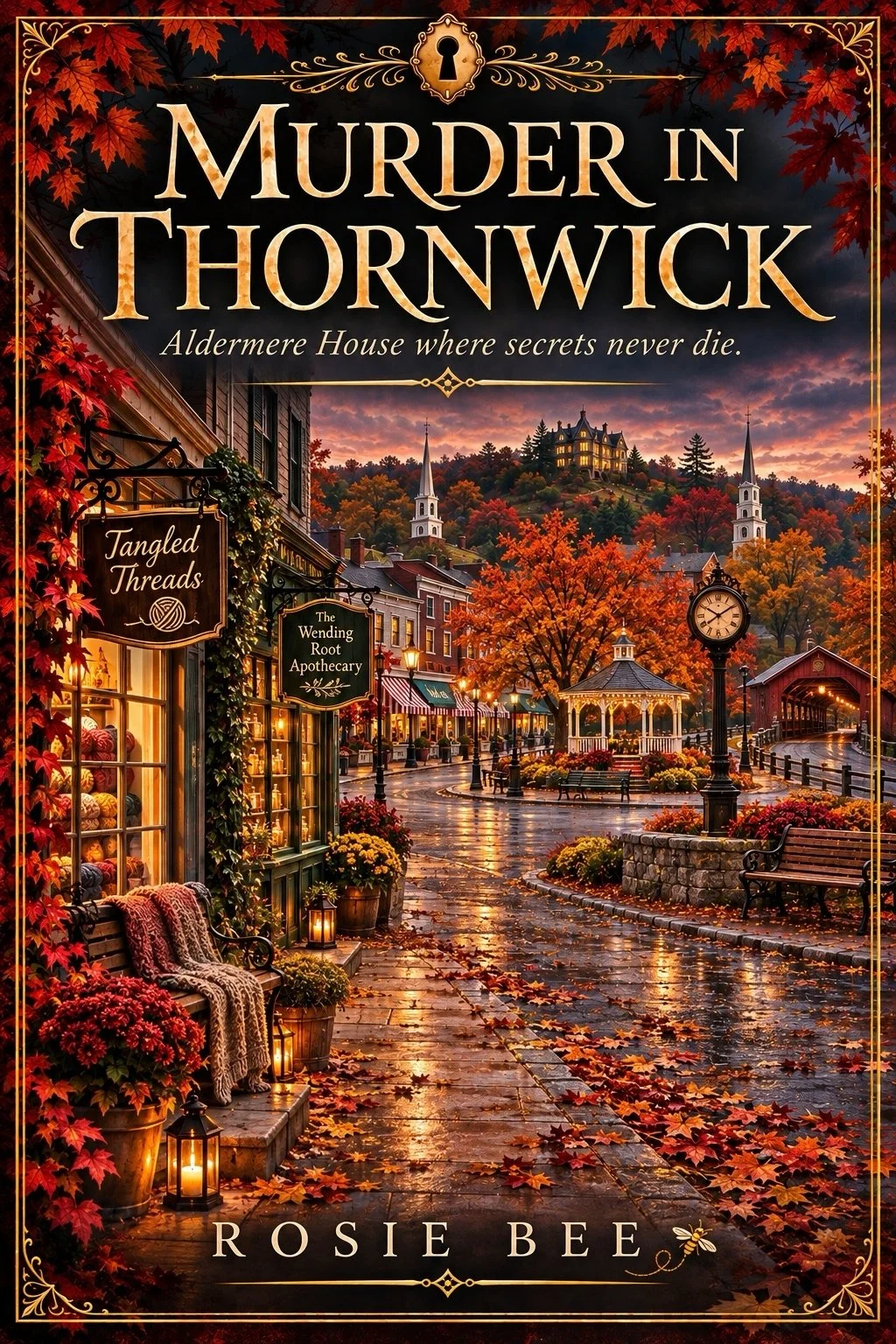
Want a taste of my new cozy mystery before it comes out December 15? Here's Chapter One — meet Ruby Delgado, her corgi Button, and the stranger who turns toward Aldermere hill, where nobody ever goes.
Chapter 1
Village of Thornwick
Button barks once, sharp and certain, and Ruby Delgado's forehead comes off the window glass with a squeak.
"That was a judgment," she tells him. "You don't bark like that at squirrels."
The corgi plants both front paws on the sill and does not look away from the street. Outside, a moving truck grinds past Tangled Threads in second gear, too long for Thornwick's square, and behind it comes a black car moving at the exact speed of someone who has never once been late.
The truck takes the turn toward the Aldermere hill.
Nobody takes the turn toward the Aldermere hill. The road up there has been a place where leaves go to collect for as long as Ruby has owned the shop, which is eleven months, which is long enough to know what the town considers normal and short enough that she still gets it wrong twice a week.
She goes out onto the step in her socks. Late October air comes straight through the wool, and she stays anyway.
The man who gets out of the black car wears a charcoal overcoat that has never been rained on. He points at the truck, then at the house, then at the truck again, and the movers move. He does not raise his voice. He does not need to.
Across the square, Cormac Linley is standing in the doorway of his café with a coffee pot in his hand and a stunned expression, which for Cormac is a rare and valuable collectible.
"Ruby!" he calls. "Are you seeing this?"
"I'm seeing it with my whole face."
"Thirty-one years," Cormac says. "Thirty-one years that house has been empty, and nobody even cut the hedge."
Button barks again. Ruby picks him up, which he tolerates the way a king tolerates a parade.
She goes back inside, past the cedar shelves and the wall of merino that she rearranged by color last spring and has been arranging back ever since, into the little office at the rear where the corkboard takes up most of one wall. It is six feet of cork and a box of pushpins and a basket of crimson yarn she has never knitted with.
She writes on a fresh notecard in her blocky art-school capitals.
ALDERMERE.
She pins it dead center and stands back.
"Okay," she says. "It's probably nothing."
Button sits in the doorway and stares past her at the window, toward the hill, and does not go to his beanbag.
The week goes the way weeks go in a town of nine hundred people: slowly, and then all at once, in one direction.
On Tuesday the man in the overcoat walks the square.
Ruby knows this because she spends most of Tuesday with a yarn swift in her hands and her shoulder against the doorframe, winding a skein that could have been wound in four minutes and takes forty. He goes into Draycott Antiquities first and stays eighteen minutes. He goes into Sweet Simons and comes out with nothing, which Ruby has never seen a human being do. He stands in front of Ivy's shop, the Wending Root, for a while without going in.
Then he comes to her.
The bell over the door is a brass one her great-aunt hung, and it has a flat, friendly clank. He steps in and the whole shop gets smaller, not because he is large but because he takes stock of it in one pass, corner to corner, the way a man reads a page.
"Hi," Ruby says. "Welcome. You're the hill."
"Harlan Voss." He does not offer a hand. "The hill."
Button trots out from behind the counter with his entire back half wagging and stops two feet short of Voss's shoes, which Ruby has also never seen him do.
Voss looks down. "Corgi."
"Button. He's usually a menace about ankles. Can I help you find something? We've got alpaca in, it's criminally soft, and if you knit at all I'll absolutely talk you into a project you don't have time for."
"I don't knit." He is already moving, slow, down the aisle between the shelves. He touches nothing. His eyes go up to the ceiling joists and down to the baseboards and across to the back wall, and he stops at the floor near the office door where the boards change from wide pine to something newer.
"Original building?" he asks.
"1874, I think? There's a plaque. Somewhere. Under a basket."
"You have the deed."
"I have a folder," Ruby says. "It's a very optimistic folder."
"Mm." He straightens. "Does the building have a cellar?"
Ruby's hands keep winding. That is the useful thing about hands that know a job. They go on without her.
"Crawlspace," she says. "There's a hatch. It mostly has spiders with opinions."
"Mm," says Harlan Voss again, and then he buys three skeins of worsted in a color called Ember, which is the exact crimson of the yarn on her corkboard, and he does not ask the gauge, the yardage, or what anyone would do with it. He pays cash. He takes the bag without looking in it.
At the door he pauses.
"Delgado," he says, reading her name off the receipt she tucked in. "You're Celestine's girl."
"Great-niece."
It comes out smaller than she meant it to. The shop is the biggest thing Ruby has ever put her name on, and she has spent eleven months carefully not asking what happens if the folder is wrong.
"Mm," he says, a third time, and the bell clanks, and he is gone up the street.
Ruby stands very still for a second. Then she goes to the back and writes a second card.
WHAT IS HE LOOKING FOR.
She pins it to the left of ALDERMERE and chews the end of her pen and does not string them together yet, because stringing is a commitment and she has rules about that. Two facts and a feeling is not a line. Two facts and a third fact is a line.
She goes back out front and sells Mrs. Hadley four buttons and absolutely does not look at the hill.
She looks at the hill nine times.
Cormac comes in at six with Poppy, who makes for Button's beanbag like a golden-retriever-shaped avalanche, and with the specific face of a man carrying news he has been keeping warm for hours.
"Just between us," he says, which is Cormac for pull up a chair, the whole town already knows.
"Go."
"He asked me for the oldest families." Cormac pulls out a stool and sits on it backward. "Not like a tourist asks. Not who's been here a while, isn't that charming. He asked which families held land before the thirties and which ones sold it. Or held it and sold it? I don't know, I was pouring. He had a notebook. Little one. Leather."
"What'd you tell him?"
"Everything, obviously, I'm not a vault." Cormac rubs his forehead. "Aldermeres, Feeneys, the Oakes outfit, the Hallorans before the fire. And then, Ruby, listen. He goes down to Samuel's and asks him about the provenance on that silver inkwell, the ugly one in the second case."
"It's not ugly, it's Victorian."
"It's Victorian and ugly, those aren't opposites." Cormac leans in. "Twenty minutes. Samuel pulls the whole catalog card, the chain of ownership, the lot. And then Voss says thank you and doesn't buy it."
Ruby stops with a pushpin halfway to the board.
"He didn't want the inkwell," she says.
"He did not want the inkwell."
"He wanted to see how Samuel keeps his records."
Cormac points at her with both hands. "That is what I said. Well. That is what I thought. I said something closer to huh."
Ruby writes the third card.
ASKING WHO OWNED WHAT, AND WHEN.
She pins it under the other two, takes a length of crimson from the basket, and runs it from ALDERMERE to WHAT IS HE LOOKING FOR, and then down to the third card, and knots it off.
"Oh, she's stringing," Cormac says happily. "It's a real one. Last time she strung yarn it was the mitten thing."
"I solved the mitten thing."
"You solved it in front of eleven people at the market and made Dot Feeney cry."
"She cried because she was moved."
"She cried because you found them in her own glovebox."
Ruby grins and then stops grinning, because Button has gotten up off the floor and gone to the front of the shop and is standing with his nose almost touching the glass, ears forward, silent.
He has not sat on his beanbag since Monday.
Ivy Corwin comes by at twenty past seven, when the shops are shut and the square has gone that deep blue it gets before the streetlamps commit. She brings back the cable needle she borrowed in September and she smells, as always, like rosemary and something warmer underneath it.
"I'd have returned this sooner," she says, "but it was being useful."
"Keep it. I've got nine." Ruby takes it anyway and puts it in the jar. "Tea?"
"No." Ivy sets her hands on the counter, flat, and looks at them for a moment, which is unlike her, because Ivy generally looks at you.
"He came to you," Ruby says.
"He stood in the doorway." Ivy chooses the words carefully, the way she measures. "For a long time. Long enough that I asked twice whether he needed anything. He said he was getting the smell of the place."
"Which is a normal thing to say."
"It would be, if he'd breathed in." Ivy turns one hand over and studies the palm. "He bought nothing. He didn't look at the shelves, Ruby. Not the jars, not the bundles, not the window display I spent a Sunday on. He looked at the counter."
"What's on your counter?"
"The register." Ivy pauses. "Not the till. The herb register. Every preparation, every date, every source, going back to my grandmother's hand. It sits open. It always sits open."
Ruby is already moving toward the back office with a notecard in her hand.
"He asked me if I had a cellar," she says over her shoulder.
Ivy follows her as far as the office door and stops there, taking in the board, the three cards, the crimson line.
Ruby writes IVY: HE LOOKED AT THE REGISTER, pins it, and runs a fresh length of yarn up to ALDERMERE.
"He's not shopping," Ivy says.
"He's inventorying." Ruby steps back and looks at the shape of it, the way she looks at a swatch before she trusts a pattern. "Deeds at Samuel's. Families at Cormac's. Your register. My floorboards. Those aren't four things. That's one thing with four handles."
Ivy doesn't answer right away. She is looking at the fourth card, and then at the yarn, and then at the fourth card again.
"Three of those are paper," she says. "Deeds, families, a register. Written records of who had what." She nods at the board. "Yours is a floor."
"He asked about the cellar. Under the floor."
"Yes. That's what bothers me. A man counting things doesn't ask where the stairs go."
Ruby opens her mouth and closes it again. The yarn she just pinned looks a little less like a line and a little more like something she wanted to be one.
"Cormac has him at an eight," Ivy says, in a lighter voice, which Ruby recognizes as a kindness.
"Out of ten?"
"The chalkboard says ALDERMERE MAN: STRANGE VIBES, 8/10. There's a doodle. I believe it's meant to be the overcoat. It looks like a bell."
Ruby laughs, and it helps, and it does not last, because the laugh dies in her throat on one word.
"He knew my aunt's name," she says. "He read Delgado off a receipt and he said Celestine. Nobody says Celestine. Half this town calls her the yarn lady."
Ivy's face changes very slightly. "Then he didn't come here to find out. He came here knowing, and he's checking."
"Checking what?"
"I don't know," Ivy says. "That's the part I don't like."
They stand with that between them for a second, and then Ivy says goodnight because Puck will have knocked something over by now, and Ruby walks her to the door and locks up behind her, and that should be the end of it.
Button barks.
Once. Low, from the chest, nothing like the one he gives the mail carrier.
Ruby turns with the key still in the lock and looks up the hill, past the dark hedge and the gate, at the Aldermere house standing in its black square of trees.
A light is on.
Not the kitchen, which faces the square and which she has watched go on and off all week. Lower, and to the left, under the east gable, in a flat stretch of stone wall where Ruby has stood on this exact step, locking this exact door, every evening for eleven months, and has never once, not one single time, seen a window.